20190723

Where there is a will, there is a way


The journalist put her microphone just a few millimeters from the seasoned minister’s mouth. He hoped the sweat he felt on his forehead didn’t make him glisten on TV. The question was about the homeless. What he planned to do about the growing number of people who had nowhere to live, not enough to eat.  He put on his serious face, nodded slowly and said that it was unfortunate that the economy had put many people on the street. Then he mentioned how much money the government had already invested in different initiatives, and he said that unfortunately there were no more resources available. The taxpayers were already under too much pressure.  

Lack of money.  Lack of time. Lack of resources in general. There are many reasons - or shall we be direct and call them excuses? - for not being compassionate. For not even trying to find a way.

Massimo Bottura didn’t hide behind any excuses when he decided to serve creative meals for those in need. He didn’t let “lack of resources” stop him.
He uses food that would otherwise go to waste.
He agreed with the church La Madeleine in Paris that he could borrow their basement.
And so many were inspired by his initiative that he has thousands of people volunteering to be part of the staff that serves food to homeless people and refugees.
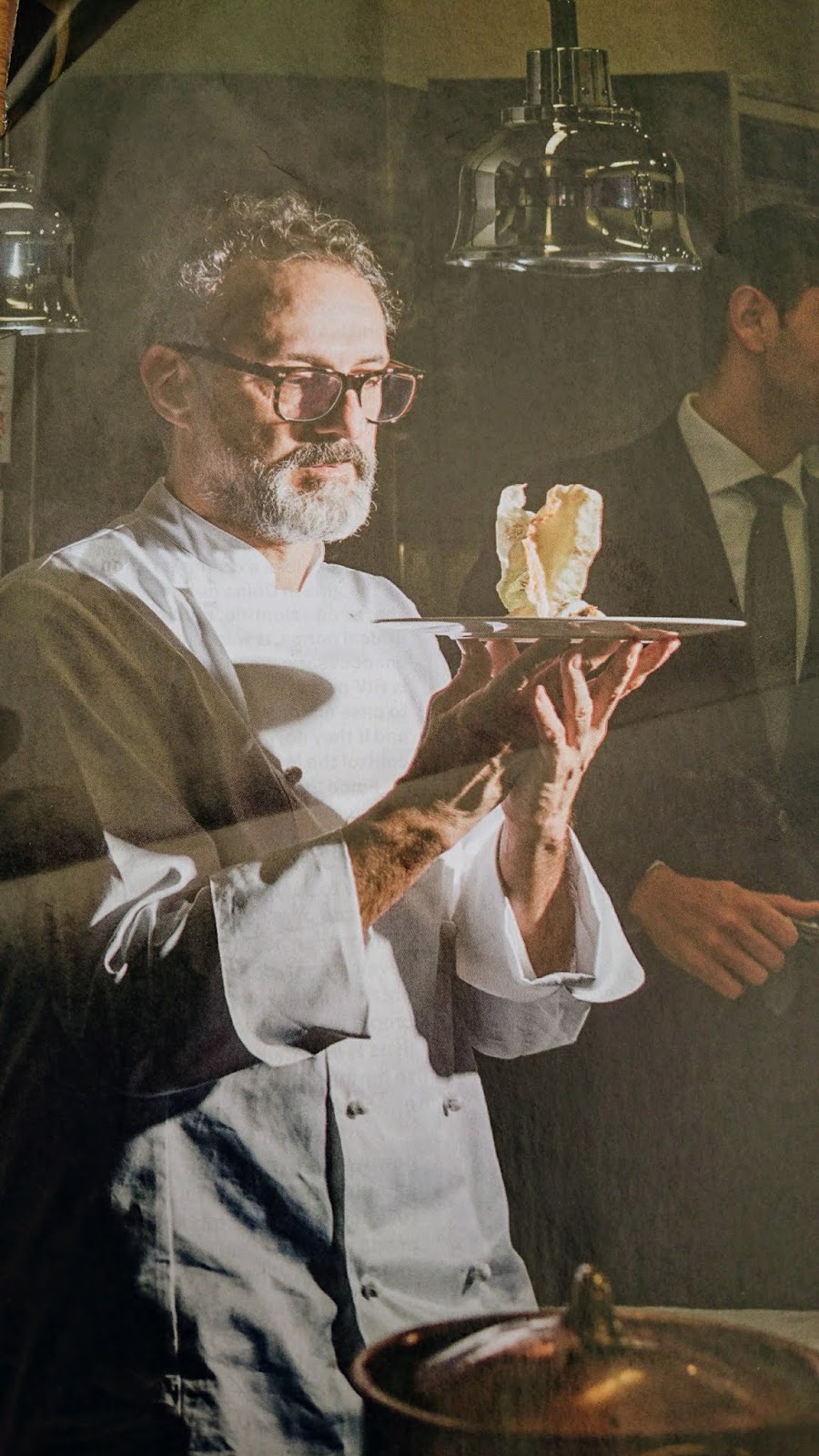
Part of a Photo by Valentina Sommariva – published in TIME April 29 - May 6, 2019.

Whenever you are about to say “I don’t have time / I don’t have the money / we don’t have enough resources”; stop yourself.
Think again.If you really want it, if it is important enough, you will find a way.  

Just like Massimo Bottura.


20190709

How to become as wise as a dwarf


Is life too short to learn how to live?

Not if you are a dwarf.

In Honey-Bee by Anatole France, a dwarf explains that the shortness of life for humans, is the cause of our ignorance and cruelty.

 “Their life is too short for them to learn how to live.”


One of my friends once said:

”Det är svårt att leva. Tur att vi har hela livet på oss att lära oss det.”(“It is hard to live. Luckily we have our whole lives to learn how to do it.”)
When I was twenty, I had figured it all out. I had learned a lot in school and even more during the sabbatical year before university. I had travelled the world, met a lot of interesting people, widened my perspectives. I knew how this thing called life worked.

It has only gone downhill since then in that regard.

The more I understand, the more I understand how little I know. The youthful certainty has made way for humble wisdom, with an awe about everything left to learn.

Is old age a guarantee of wisdom and knowledge?

Unfortunately not. I have met old people with minds so narrow they have not learned anything new in decades. You probably have too.

As Indiana Jones said in the Raiders of the lost ark:
 “It’s not the years honey, it’s the mileage.”
If you want to learn how to live, long before you die, make good use of every day of your life. Increase the mileage - your experience – instead of letting the years just go by.

Turn off the auto pilot.

Do something you don't do everyday. 

Take another road than the one you normally travel.

Dare to deviate, to explore.

Then you may become just as wise as a dwarf, despite your shorter life.


20190611

Not even good people are good in a hurry


It’s Thursday morning, 7:12.

Breakfast club at school has already started. Lyndsey parks the car opposite to the school. Before the car has come to a halt, she asks her daughters to hurry up, to grab their bags so they can run out of the car and to the school. As always when there is no time, the little one cannot get her seat belt off and the oldest forgets the gym clothes in the car, so they must go back again, just as they were about to cross the street. 7:16. Will school let her children eat breakfast when they are this late?

Just outside of school there is a little boy, five years old. He is alone, crying. Looking at each grown up that passes him by. When Lindsey crosses the street with her daughters, he looks at her too. His lips trembling, his eyes hopeful. Lindsey rushes past the little boy, hunches down to kiss her girls goodbye before rushing back to her car to get to work.


It’s Thursday morning, 6:52.

Breakfast club starts in 8 minutes. They have plenty of time. Lyndsey parks the car opposite to the school. She talks to her daughters about their day, all the things they will do. The little one needs some help with the seat belt. Lindsey reminds the oldest to bring the gym clothes as well. As they cross the street they talk and laugh. Lindsey sees a little, sad boy just outside of school. When she comes up to him, she sits down, asks why he is sad. Has he lost mum and dad? The boy nods, tears rolling down his cheeks. Lindsey pulls him to her chest, explains that everything will be alright, she will help him.


Photo by Nicholas Githiri from Pexels

John Darley and Daniel Batson, two Princeton University Psychologists, performed a study based on the biblical story of the good Samaritan. Some seminarians in the study were told they were late. Others were told they had enough time. Of those who felt they had time, 63% stopped to help a person in distress. Only 10% of those in a hurry stopped.

Not even good people are good when they are in a hurry.

In Malcolm Gladwell’s bestseller The Tipping Point, this is referred to as “the power of context”.

Don’t let time pressure turn you into someone you don’t want to be.
Manage your time – manage your life.

20190528

What you are ready to die for, others don’t even want


It’s European election night as I write this, and I am in Kiev, Ukraine. A few days ago, I visited Independence square, or as they call it here: Maidan Nezalezhnosti. Walking on that square and reading more about what happened here 5 years ago, reminded me that some are willing to die for what others take for granted, or don’t even want.

Euromaidan started November 2013 on the Maidan. It was a wave of demonstrations, sparked by the Ukrainian government's decision to suspend the signing of an association agreement with the European Union. There was more to it, including the perception of widespread government corruption and violation of human rights in Ukraine. The protests culminated in February 2014. More than 100 protesters were killed. Here in Ukraine the victims are often referred to the Heavenly Hundred.


In one country, people get killed for wanting to get closer to the EU. In another, discussions about how to leave the EU continue for months. And the weekend I write this, during election night, a lot of EU citizens have not even bothered to vote.

Regardless of what you think about any of this, it is a reminder that you may be willing to die for something that others don’t care about or don’t even want.
What does that mean for you?
That you should listen to your inner voice.
Don’t doubt it just because others may think differently.

  • Do you want to go for your own business rather than staying in your current job, but you doubt yourself because your colleagues are perfectly happy being employed?
  • Or are you the one loving your job, but feeling as if you should be making a major change?
  • Is everyone around you getting married, expecting you to be too, even if you like your life as single with short relationships?
  • Do you wonder if it is time to get children, even if you don’t feel ready for it?

You will not find the answers by looking at others. They are not you. Only you are you.

Give yourself at least five minutes a day, to listen to your own voice. If you haven’t heard it for a while, be patient. After some practice, the chatter in your head will calm down enough for you to hear it.

You may love what someone else doesn’t care about.
That’s OK.
Figure out what is right for you, regardless of what others do. Then give it all you’ve got.

20190514

Become a terror management expert


 “So how will you celebrate your big day?”

Anne smiled at Agnes. The smile put wrinkles around the grey eyes.
Carmel winced.

“Oh please, don’t talk about it. Forty years old. It is hardly something to celebrate, is it?

Anne leaned backwards. They were sitting in her kitchen, having afternoon tea together. Like they did every Wednesday.

“Well, it’s better than the alternative”, she said, with the calm voice Carmel recognized from her childhood, when Anne’s house had been her second home.  

“I know, I know. I am happy to be alive and healthy. But knowing that from now on it will all go downhill… I don’t know, I find it scary. From now on my health will get worse, my parents will need more and more help - they are almost as old as you are – and if I want to change careers it will be hard.”

Anne put her thick grey hair behind her ear, still smiling.

“I know, Carmel continued, “that it seems silly to say that to you. How old are you now?”

“Oh, old enough not to count. Forty-eight is all I remember.”

“Forty-eight? You are in your seventies, aren’t you?”

“Yes, I suppose I am, I was born in nineteen forty-eight so… seventy-one this year.”

“Well, isn’t lonely to be without your parents? And then your hip…”

“I have never been happier.”

Carmel’s eyes widened.
“Really?”

“I used to worry so much. I don’t worry anymore. There is no point. So, I will die soon? What else is new? Meanwhile I can enjoy being with my grandchildren.”

Carmel let her finger trace the rim of the teacup. Anne sensed her embarrassment and gently caressed her hand.

 “I felt the same when I was your age. I was worried about growing old. If I had known then how much I would enjoy it, I could have saved myself so much worry.”

Photo by Italo Melo from Pexels

Jeffrey Kluger wrote in TIME about “The surprising joy of old age”. Psychologists and other investigators have found that old age is often a time defined not by sorrow, dread and regret but rather by peace, gratitude and fulfillment. They conclude that seniors become masters of “terror management theory”.

How about not waiting until you get old?
Stop worrying and make the most of what you have here and now!

20190430

You don’t need a smoke. You need a break.

Paul, who had been hunched over with his nose close to the computer screen the whole morning, suddenly sat up. For a short moment he held his head with both hands, making his hair messy. Then he stood up.
“I need a break. I will go for a walk.”
Paul walked out, putting on the jeans jacket just before leaving the office landscape.

Lindsey rolled her eyes and turned to the colleague next to her.

“Going for a walk? What does he think we are doing here? Playing around, only working when we feel like it? We got work to do and he just walks out, leaving us here!”
With an annoyed frown, she continued working.

When Paul came back fifteen minutes later, he had a big grin on his face.
“I got it!”, he said, starting to type as soon as his rear touched the chair.
Lindsey couldn’t stand Paul. Young, talkative and just not responsible enough. He gave her a headache. She closed her eyes for a second. The urge became stronger.
“I need a smoke”, she explained to her colleague, grabbed the package of cigarettes and headed for the door. On the way she saw something in her colleague’s eyes. “What?”
“Going for a smoke? What do you think we are doing here? Playing around, only working when we feel like it?”
--


Photo by Kelvin Valerio from Pexels

Taking breaks is good for creativity and for our health. Still, many work places have a culture where some breaks are accepted while others are not.

I am in touch with people who use smoke breaks to get a break – not because they want to smoke.

 If it would be accepted to take a walk break, a sit-in-silence break, a listen-to- music break, we would increase creativity and efficiency and our employees would be a lot healthier.

Is it time to change how you look at breaks in your work place?

Then initiate that change!

20190423

Shrinks, mates and grandmothers


The 15-year-old girl walked unsteadily towards the bus stop. Her hands were shaking like those of an old lady with Parkinson. The anxiety was hard to fight. Her throat felt cramp, her heart was fluttering, and black spots danced in front of her eyes. She didn’t want to get on a bus filled with strangers. She didn’t want to go further than she had ever gone, to the big city she had never been to. Her mother had asked her to go, urged her to go. Maybe this was her only chance. Mum had emptied the jar with food money and pushed the bills and coins in her hand.

When the bus stopped in front of her, she almost fainted. An older man helped her get into the bus. She asked the driver what the ticket would cost. When she heard the price, a price so much higher than all the money mum had given her, she stumbled back out, running away, dropping a letter on the ground. The man who had helped her on to the bus picked up the letter. Invitation to psychiatric evaluation. When he looked up the girl was gone. A few hours later she was found hanging from a tree.

I am sorry to say that the story is based on real events, as described by Eben Shapiro in the article A humble solution to global depression in TIME.  16,5 million people live in Zimbabwe, a country with 12 (!) trained psychiatrists. The 15-year-old girl was on her way to one of them, Dr. Dixon Chibanda, for a scheduled evaluation. She couldn’t afford the $15 bus fare and hanged herself.

Dr Dixon Chibanda decided to do something to improve the situation for others in her situation. With only 12 psychiatrists in the country, something had to be done to increase access to help.
“It suddenly dawned on me that one of the most reliable resources we have in Africa is grandmothers.”
This reminds me of a scene in the film Crocodile Dundee, when Dundee is surprised about Americans talking about their “shrinks” and asks why they don’t just talk to their mates.  

Mates and grandmothers are great when it comes to offering help. When it comes to psychiatric illnesses you will need more skills, so Dr Dixon Chibanda’s organization Friendship Bench trains Zimbabwean grandmothers in problem-solving therapy and behaviour activation.

There is no such thing as unsolvable problems. Too often we limit ourselves by thinking we don’t have the resources. Not enough psychiatrists, not enough money, not enough time. When you switch your mind to: “There is always a way”, you will find the solutions.

Like Dr Dixon Chibanda, who decided to, and found, a way.
You can read more about Friendship Bench here.